
The United States action of levying 25 per cent additional tariff on Indian goods is 'unfair, unjustified and unreasonable', India said on Wednesday in a firm reaction, signalling increasing tensions between the two strategic partners over New Delhi's energy ties with Moscow.
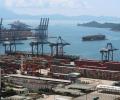
With the Iran war escalating sharply and crisis deepening in the global energy market, India on Monday unveiled a coordinated plan to support exporters and shippers caught in the fallout.
Donald Trump's tariffs, meant as political punishment, have avoided the predicted chaos, lifting US growth, weakening rivals, and letting him claim victory in a resilient global economy, observes T T Ram Mohan.
In trade negotiations, as in chess, sometimes you need to accept a temporary disadvantage to secure a better long-term position, points out Sonal Varma, chief economist (India and Asia ex-Japan) at Nomura.
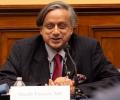
Senior Congress leader Shashi Tharoor says US tariffs are negatively impacting India, leading to job losses, and criticizes President Trump's diplomatic behavior.
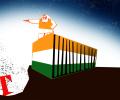
The crisis may not be as visible this time, but the stakes are just as high, points out Rajeswari Sengupta.
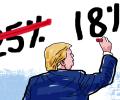
The Congress party has criticized the Indo-US trade agreement, calling it a 'surrender' of India's self-esteem and interests, and a betrayal of Indian farmers and MSMEs.

State governments have requested the Centre for export incentives, lifting of import duty in the case of cotton for the textile sector and GST exemptions.

The Gems and Jewellery Export Promotion Council (GJEPC) has urged the Centre to provide immediate relief measures as the tariffs imposed by the United States have started hitting the industry. US tariffs of 50 per cent on Indian goods came into effect on August 27.

'The biggest point of contention is market access for US agricultural and dairy products.'

Will rising tensions between US-Israel and Iran threaten crude oil supply through the Strait of Hormuz, putting India's fuel prices, imports, and economic stability at risk?

'Just as we cannot surrender the interests of our farmers and dairy industry, Trump is also looking for markets for the produce of the farmers in the Midwest, which are his support base.'

India's economy experienced a growth of 7.8 per cent during the October-December quarter of 2025-26, according to the new series of national accounts with 2022-23 as the base year.

Inflation data, trading activity of foreign investors and global trends would dictate sentiment in the stock market this week, according to analysts.

Civil unrest in Iran has started impacting India's basmati rice exports to the country, leading to a sharp fall in domestic prices, as exporters face payment delays and mounting uncertainties, an industry body said on Tuesday. The Indian Rice Exporters Federation (IREF) urged exporters to reassess risks on Iranian contracts and adopt secured payment mechanisms, warning against over-leveraging inventories meant for the Iranian market.

Bitcoin has fallen from its peak of $1,26,251.3 on October 6, 2025, to $65,405.5, a decline of 48.2 per cent. Investors must recognise that sharp volatility is inherent to Bitcoin and avoid kneejerk reactions.

Investors should tilt their portfolios towards domestic-facing defensive sectors, which should help provide stability and shield them from geopolitical and tariff risks.

US President Donald Trump has announced a 25 per cent plus tariff on India from Aug 1. Trump, describing India as a "friend", said the US has done relatively "little business" with the country because of its high tariffs.

India and the European Union are set to announce on January 27 the conclusion of negotiations and finalisation of a free trade agreement, which is aimed at boosting economic ties between the two regions amid disruptions in global trade due to US tariffs, an official said.

Many fans hadn't even bothered to change their Team India jerseys with which they watched the match. A few wanted to carry on the stadium atmosphere into the train singing songs like Chak De India and Vande Mataram. They played them so loudly and ensured no one got a wink of sleep. Of course, the main topic of discussion was Sanju Samson.

Prime Minister Narendra Modi stayed calm, avoided public confrontation, and focused on India's long-term interests to steady ties with the United States.

Speculation about rising competition from global majors has led to shares of major Indian automobile manufacturers such as Mahindra & Mahindra (M&M), Maruti Suzuki India, and Tata Motors taking a hit on the BSE.

India has been on an FTA-signing spree of late. Since 2021, it has signed eight trade agreements, three of which -- with the UK, Oman and New Zealand -- were finalised in 2025 alone.
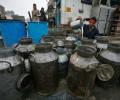
India has fully protected its sensitive sectors like dairy, rice, wheat, pulses, tea, genetically modified (GM) goods, and coffee by not granting any import duty concessions to the European Union (EU) under the bilateral free trade agreement, according to the Commerce Ministry.

The Swiss government would not object to tennis legend Roger Federer or FIFA President Gianni Infantino intervening to reduce the country's tariff burden after the US slapped a 39 percent import duty on its goods, President Karin Keller-Sutter said.

The Kremlin has stated that India is free to purchase oil from any country, dismissing claims that India agreed to reduce Russian oil imports. Russia maintains that energy trade with India benefits both nations and contributes to international energy market stability.

Benchmark indices Sensex and Nifty ended marginally higher on Wednesday as a sharp decline in IT blue-chip stocks restricted the rally in the markets.

The rupee witnessed a volatile trading session and settled for the day on a slightly lower note, down 1 paisa at 90.66 against the US dollar on Monday, as traders assessed the details of the India-US interim trade framework.

China's ruling Communist Party is holding its annual leadership conclave to discuss the new five-year plan, the impact of US President Donald Trump's tariff war, and the ongoing anti-corruption crackdown in the military.

Replacing over a third of India's oil imports at competitive rates is going to be a challenge, said traders from State refiners, even though some progress was made in the last two months.
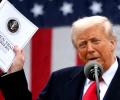
United States President Donald Trump has backed a sanctions bill that could impose 500 per cent tariffs on countries buying Russian oil, giving the White House leverage against countries like China and India to stop them from purchasing cheap oil from Moscow.
Industry leaders urge India to pursue diplomatic talks with the US, strengthen manufacturing, and consider China ties to gain leverage against tariff pressures.

The question is no longer whether the war will expand. It has. The next few days will tell us whether the war stabilises around Hormuz or whether the Strait itself becomes the trigger for a far larger rupture. What to watch for over the next 48 hours is simple: Any move by the US toward direct naval control of the Strait; any credible Iranian attempt to disrupt or mine shipping lanes and, critically, whether energy infrastructure in the Gulf continues to be targeted.If those lines are crossed in tandem, the war will no longer be containable within the region.

Indian envoy Vinay Mohan Kwatra discussed fair, balanced and mutually beneficial trade ties with US lawmakers amid ongoing tariff tensions between New Delhi and Washington.
S&P Global Ratings on Monday said several Asia-Pacific economies could face higher tariffs under the Trump administration, while India, South Korea, and Thailand could be most vulnerable to trade retaliation. In its report titled 'Asia-Pacific Economies Likely To Be Hit By US Trade Tariffs', S&P said economies like Vietnam, Taiwan, Thailand, and South Korea have relatively greater economic exposure to the US, meaning that tariffs, if imposed, would have the largest economic impact.
The comments come ahead of Trump's high-profile meeting with Russian President Vladimir Putin, scheduled for Friday in Anchorage, Alaska.
The White House has claimed that India has begun 'scaling back' its oil purchases from Russia at the 'request' of President Donald Trump.
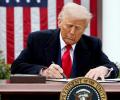
No experts, clearly, were involved in the design of these new tariffs, which have been the subject of bemused wonderment across the world in how completely they ignore logic, rationality, fairness, and economic theory, observes Mihir S Sharma.

The US retaliatory tariffs are a major setback for the Indian gems and jewellery exports, apex industry body GJEPC said on Thursday as it urged the government to take steps to secure the long-term interest of the sector. The US has announced 27 per cent reciprocal tariffs on India saying New Delhi imposes high import duties on American goods, as the Donald Trump administration aims to reduce US' trade deficit and boost manufacturing.
Several farmer organisations in India are protesting the proposed India-US trade deal, expressing concerns about its impact on the agriculture sector and demanding the resignation of the Commerce Minister.
 © 2026 Rediff.com - Advertise with us - Disclaimer - Privacy Policy - Sitemap - Feedback - About us - Terms of use - Grievances